
SPC AIAG VDA Yellow Volume makes us to raise the question: is a process with Cpk = 1.75 always safe?
In many organizations, the answer would be yes. The result meets customer requirements, the report looks correct. The PPAP is approved. However, SPC Yellow Volume shows that this interpretation may be overly simplified. The issue is not the mathematics. The issue is the order of thinking.
For years, companies often started with the index. SPC Yellow Volume makes one principle very clear: we must start with process stability. Only then can we talk about capability. This shift is not cosmetic. It affects reporting logic, operational decisions, leadership accountability, and ultimately business risk.
In this article, we will guide you through:
- the background of the harmonization,
- the renewed emphasis on process stability,
- the difference between performance and capability,
- the impact on PPAP,
- the link between SPC, MSA, and FMEA,
- and the strategic implications for Quality Managers.
Why Was SPC AIAG VDA Yellow Volume Created?
For many years, the automotive industry operated under two parallel interpretations. The American AIAG methodology emphasized the distinction between “within” and “overall” variation. Meanwhile, the German VDA approach placed stronger emphasis on confirming statistical stability before declaring capability. In practice, this created ambiguity. The same process could be interpreted differently depending on which handbook was referenced. SPC Yellow Volume harmonizes these perspectives. However, this is not a mathematical compromise. It is a philosophical alignment.
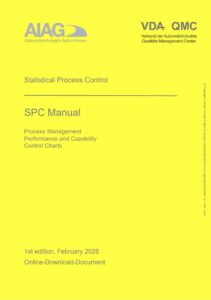
The key message is simple:
You cannot claim capability if the process is not stable.
By reinforcing this principle, SPC Yellow Volume aligns with ISO 22514 and traditional VDA thinking while maintaining AIAG structure.
Process Stability – The Foundation Reinforced by SPC AIAG VDA Yellow Volume
Process stability is not a new concept. It has existed in statistical theory for decades. However, in industrial practice, it has often been treated as a formal checkpoint rather than a real decision criterion. SPC AIAG VDA Yellow Volume restores its central role.
A stable process is one in which variation results only from common causes. The control chart shows no special cause signals, no trends, and no systematic patterns. In other words, the process behaves predictably over time.
Why does this matter?
Because capability indices assume stability. If that assumption is violated, interpreting Cpk becomes risky. Imagine a process showing a clear upward trend. Today it remains within specification. Next week, it may not. In such a case, a high Cpk describes the past, not the future.
That is precisely why SPC Yellow Volume changes the hierarchy: first analyze the control chart. Then calculate and interpret the indices.
Performance vs Capability – Clarified in SPC AIAG VDA Yellow Volume
One of the most important clarifications introduced by SPC Yellow Volume is the explicit distinction between performance and capability.
When Do We Use Pp/Ppk?
Pp and Ppk describe actual process performance over a defined dataset. They do not assume statistical stability.
They are appropriate when:
- stability has not yet been confirmed,
- the process is in a pre-series phase,
- production is still stabilizing.
For this reason, in PPAP submissions, Pp/Ppk are generally the correct choice under the logic of SPC AIAG VDA Yellow Volume.
When Do We Use Cp/Cpk?
Cp and Cpk describe process capability, but only if the process is statistically stable and continuously monitored using control charts. If stability has not been confirmed, reporting Cpk may be challenged during a customer audit.
The formulas remain unchanged. However, the interpretation framework under SPC AIAG VDA Yellow Volume is now clearly defined.
Cw/Cwk and Pm/Pmk – Terminology Alignment
To preserve continuity with previous AIAG methodology, SPC AIAG VDA Yellow Volume introduces Cw/Cwk to explicitly represent “within” variation. In addition, Pm/Pmk replace former Cm/Cmk as machine performance indices.
The shift from “C” to “P” reflects a key principle: short-term machine studies confirm performance, not long-term capability.
This clarification eliminates much of the historical confusion surrounding machine studies.
The Impact of SPC AIAG VDA Yellow Volume on PPAP
SPC Yellow Volume directly influences how PPAP documentation should be structured.
In the pre-series phase:
- long-term behavior is not yet fully known,
- sample sizes (e.g., 125 parts) may not confirm stability,
- process variation may still be evolving.
Therefore, reporting Pp/Ppk is typically appropriate. Only in serial production, after statistical stability has been demonstrated, should Cp/Cpk be reported as true capability indices.
Organizations must clearly define when the transition from performance to capability occurs in line with SPC Yellow Volume.
SPC and MSA – A Reinforced Relationship
Under SPC AIAG VDA Yellow Volume, the link between SPC and Measurement System Analysis becomes even more critical. If the measurement system is unstable, any evaluation of process stability becomes unreliable. Apparent variation may stem from measurement error rather than the process itself.
Therefore, SPC interpretation must be supported by verified:
- repeatability,
- reproducibility,
- linearity,
- measurement system stability.
Without credible MSA, capability analysis loses meaning.
SPC and FMEA – From Charts to Risk Management
SPC Yellow Volume strongly supports risk-based thinking. A special cause signal is not merely a statistical anomaly. It represents increased operational risk. Ignoring such signals may lead to customer complaints, warranty claims, and escalations.
Therefore, SPC should be integrated with:
- Process FMEA,
- Control Plans,
- escalation processes,
- corrective action systems.
Only then does SPC become a proactive management tool rather than a passive reporting system.
Common Misinterpretations of SPC AIAG VDA Yellow Volume
Despite the clarity of the new structure, several misinterpretations persist:
Automatic Cpk reporting without stability confirmation.
Superficial control chart analysis.
Treating Pp/Ppk as inferior indices.
Failing to link SPC results to operational decision-making.
SPC AIAG VDA Yellow Volume leaves little room for these practices.
What SPC AIAG VDA Yellow Volume Means for Quality Managers
This update is not simply a technical revision. It requires reviewing how statistical evidence is interpreted within your organization. Quality Managers should verify whether stability is truly demonstrated before capability is declared. Reporting procedures and PPAP documentation must clearly distinguish between performance and capability.
Production leaders must also understand the operational implications of ignoring special cause signals seen in control charts. SPC Yellow Volume therefore demands statistical competence, but also leadership maturity.
FAQ – Frequently Asked Questions About SPC AIAG VDA Yellow Volume
Does SPC Yellow Volume change required Cpk thresholds?
No. SPC Yellow Volume does not change the numerical acceptance criteria for Cp/Cpk or Pp/Ppk. The mathematical formulas and commonly used thresholds (e.g., 1.33 or 1.67) remain the same. What changes is the interpretation framework. Capability indices may only be reported if statistical stability has been demonstrated.
Can Cp/Cpk be reported in PPAP under SPC Yellow Volume?
Only if process stability has been clearly confirmed using control charts.
In most pre-series situations, stability cannot yet be fully demonstrated. Therefore, SPC Yellow Volume recommends reporting Pp/Ppk during PPAP unless long-term stability evidence exists.
Does SPC AIAG VDA Yellow Volume replace Cp/Cpk with Pp/Ppk?
No. Both sets of indices remain valid. However, SPC Yellow Volume clearly defines their application:
- Pp/Ppk describe process performance when stability is not confirmed.
- Cp/Cpk describe capability only after statistical stability is proven.
The distinction is conceptual, not mathematical.
Are 125 samples enough to prove stability according to SPC Volume?
Not necessarily. Stability is not confirmed by sample size alone. It must be demonstrated over time using appropriate control charts. Even 125 consecutive measurements cannot guarantee stability if trends or special causes are present.
What is the difference between capability and performance in SPC Yellow Volume?
Performance reflects how the process actually behaved during a defined period. Capability reflects the potential of a stable and predictable process.
Under SPC Yellow Volume, this distinction becomes central. Capability assumes predictability. Performance does not.
Does SPC Yellow Volume apply only to automotive?
The document was developed for the automotive industry; however, its statistical principles apply broadly to any manufacturing environment where process capability and risk control are critical.
Listen to our podcast
Conclusion – A Strategic Shift in Quality Thinking
SPC AIAG VDA Yellow Volume does not change statistical formulas. It changes decision logic.
First stability. Then capability.
First process behavior. Then the index.
This structured thinking reduces risk, increases predictability, and strengthens quality culture. Ultimately, quality is not defined by numbers alone. It is defined by how responsibly those numbers are interpreted.
Prepare Your Organization for SPC AIAG VDA Yellow Volume
At QualityWise®, we support manufacturing organizations in implementing SPCin a practical and structured way.
We provide:
- practical SPC training,
- workshops on process stability interpretation,
- MSA training as the foundation for reliable data,
- PPAP support.
If you want to ensure that your organization interprets capability correctly and avoids audit nonconformities, visit www.qualitywise.pl or book a free consultation.
Hope you found the article interesting.
Thank you for your presence.
All content on the qualitywise.pl website is a private interpretation of publicly available information. Any convergence of the described situations with people, organizations, companies is accidental. The content presented on the website qualitywise.pl does not represent the views of any companies or institutions.