The audit is over. Your organization has received the report, and the findings have been entered into a tracker with owners and deadlines. Some actions can be completed quickly: revise a form, add a missing record, retrain an employee, or update a procedure. Over the next few weeks, items move to “closed,” and the situation appears to be under control.
Then the next audit begins. Once again, the auditor finds inconsistent documents, ineffective actions, unclear ownership, or a process that works differently from the system description. The wording of the finding may have changed, but the underlying source remains the same.
Therefore, managing audit findings should never be reduced to managing a task list. The real objective is to remove causes, verify effectiveness, and embed the change in the way the process is managed every day.
A gap does not disappear when you close a task. It disappears when the process works effectively without another last-minute push before the next audit.
A list of audit findings is not yet an improvement plan
An audit report shows what the auditor identified in the sample examined. Depending on the type of audit and the reporting rules, it may include nonconformities, observations, risks, or opportunities for improvement. However, the list itself does not explain why the problem occurred or how far it extends.
If the organization treats every finding as a separate administrative task, it can quickly create a plan that looks well organized:
- revise the work instruction;
- conduct training;
- complete the form;
- remind employees of the requirement;
- introduce an additional inspection.
Each of these actions may be necessary. However, none of them proves that the cause of the gap has been removed.
A revised document will not help if the change never reaches the workstation. Training will not solve a poorly designed process. Likewise, an additional inspection may reduce immediate customer risk without removing the mechanism that creates the nonconformity.
An effective improvement plan must connect the finding with the requirement, evidence, risk, cause, ownership, and effectiveness criteria. Only then does the audit report become a management tool.
Why do the same gaps return?
A recurring gap does not always mean that the organization did nothing. More often, it means that the action was too narrow or that the result was not sustained.
Pressure to close the audit report on time is one common cause. The team focuses on providing a missing document, signature, or training record. Meanwhile, the effectiveness review is reduced to checking whether the assigned task was completed.
Another problem arises when every finding is assigned to Quality. A Quality Manager can coordinate actions, challenge weak evidence, and maintain the problem-solving method. However, Quality cannot independently change production planning, process parameters, tooling design, purchasing rules, or resource decisions.
Gaps also return when the organization:
- accepts the first possible cause without confirming it;
- confuses correction with corrective action;
- fails to check similar processes, products, or locations;
- assesses effectiveness too soon;
- leaves related documents and control methods unchanged;
- does not build the lessons into process-owner competence;
- removes temporary controls before confirming process stability.
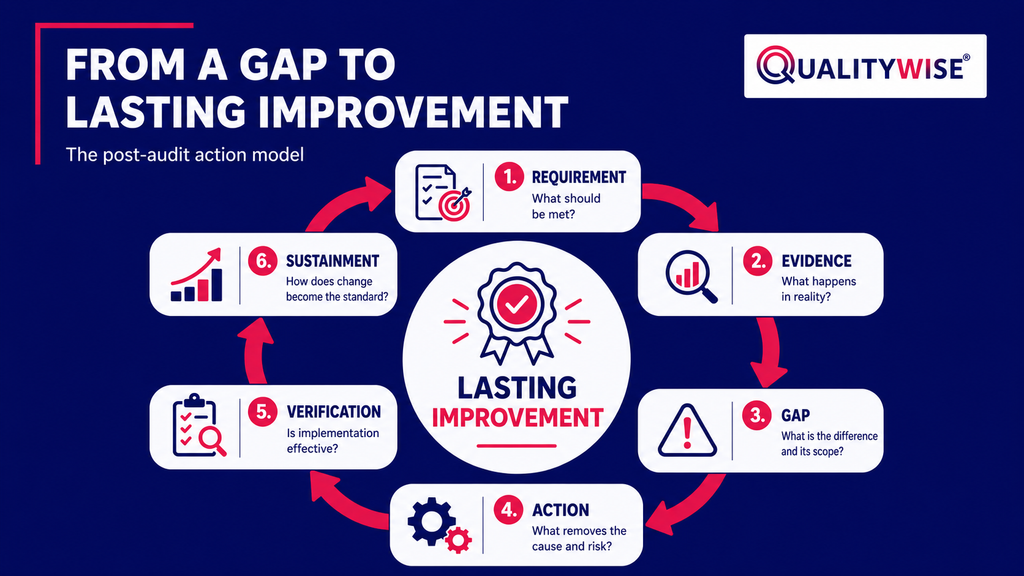
To break this cycle, use a six-stage model.
The model: requirement → evidence → gap → action → verification → sustainment
This model does not replace 8D, PDCA, or your corrective action procedure. Instead, it organizes the logic of the response and helps you check whether a critical step is missing between the finding and a lasting result.
1. Requirement — confirm the actual requirement
First, confirm the criterion used to assess the process. The source may be a customer requirement, a standard, a technical specification, an approved procedure, or an internal company standard.
Do not stop at a clause number or document title. Determine what the requirement expects in practice, which process it applies to, and what result should be visible.
If the team does not understand the intent of the requirement, it may create a formally acceptable response that does not work operationally.
2. Evidence — separate facts from opinions
Next, collect evidence that shows the actual condition of the process. This may include records, observations, employee interviews, results, product samples, process settings, or comparisons between related documents.
Evidence should answer one question: “What actually happened?” It should not include an unverified explanation.
For example, the statement “the operator did not follow the instruction because they were not trained correctly” combines an observation with an assumed cause. First, confirm how the operator performed the task, which instruction was available, what training had been completed, and what conditions existed at the time.
3. Gap — define the difference and its extent
A gap is the difference between the required condition and the actual condition. Its description should state:
- what the criterion required;
- what the evidence showed;
- where the difference occurred;
- which sample the finding covered;
- what risk it may create;
- whether a similar condition could exist elsewhere.
At this stage, do not declare a cause unless it has been verified. A precise problem statement is the basis for the analysis that follows. Otherwise, the team may solve the wrong problem very effectively.
4. Action — match the response to the cause and risk
The response may require several different levels of action.
Containment limits the immediate risk to the customer or process. Examples include an additional inspection, a shipment hold, or a review of inventory.
Correction removes the detected case. For example, the organization may correct an inaccurate record or replace a nonconforming component.
Corrective action removes the cause so that the problem does not recur. Therefore, it requires a verified cause analysis and an action that addresses the mechanism behind the gap.
Systemic action applies the lesson to similar processes, products, documents, or locations. As a result, the organization does not wait for the same problem to be found somewhere else.
Every action should have an owner, a deadline, the required resources, an expected result, and evidence of completion. This is the logic behind problem solving as a management process, rather than merely a method for documenting an answer.
5. Verification — confirm implementation and effectiveness
Verification should take place at two levels.
First, verify implementation. Was the new instruction approved? Was the previous version withdrawn? Did employees receive the right tools? Were the process settings changed?
Then assess effectiveness. Are employees actually following the new standard? Has the process result improved? Does the reaction plan work? Has the problem remained absent over a suitable period and across a representative sample?
An attendance sheet confirms participation in training, but it does not confirm competence. An updated document confirms a change in wording, but it does not prove a change in practice. In the same way, a closed task is not evidence of effectiveness.
Define the effectiveness criteria while planning the action. Otherwise, several weeks later, the team may not know what result it should be looking for.
6. Sustainment — embed the change in the daily system
Even an effective action can weaken if it depends only on the memory of the people involved. The final stage is therefore to sustain the result.
Depending on the gap, this may require updates to:
- the PFMEA and Control Plan;
- work instructions and the reaction plan;
- competence criteria;
- the internal audit program;
- the Layered Process Audit checklist;
- process indicators;
- change management rules;
- the lessons learned repository;
- standards for similar products or processes.
A Layered Process Audit can help sustain an agreed standard, especially when regular observation of daily work is important. However, it should not be used to hide an unstable process behind an ever-growing number of checks.
How do you turn an audit report into a manageable plan?
Not every finding has the same significance. Therefore, the first step should not be to work through the list by the shortest deadline. It should be to assess risk.
Give priority to gaps that:
- may affect safety, product conformity, or the customer;
- appear in several processes or locations;
- have occurred before;
- require product or shipment containment;
- reveal that a core system mechanism is ineffective;
- require a management decision or additional resources.
Then, for every significant gap, define:
- the applicable requirement;
- the confirmed evidence;
- a precise description of the gap and its extent;
- the process owner;
- the necessary containment;
- the root cause analysis method;
- an action based on the verified cause;
- the criteria and timing for the effectiveness review;
- the method for sustaining the result;
- whether the lesson must be applied to other processes.
Quality may maintain the central tracker and monitor progress. However, the process owner should be accountable for changing the way the process works and sustaining the result. Management must make the decisions when the solution requires investment, a change in priorities, or formal acceptance of risk.
How can you recognize superficial actions?
A superficial action often looks credible in the tracker. It has an owner, a deadline, and an attachment. Only an observation of the process reveals that the problem remains.
Warning signs include situations in which:
- every analysis ends with additional training;
- the cause is always described as operator error;
- the form changed, but the decision-making process did not;
- the instruction was revised, but the old practice remains at the workstation;
- an additional inspection became a permanent solution;
- effectiveness was confirmed from one positive sample;
- the action was closed immediately after implementation;
- nobody checked similar processes;
- Quality closed the task on behalf of the process owner.
Be particularly careful when training becomes the automatic response. Training is appropriate when a real competence gap caused the problem and the organization can define what the employee must learn and how they will demonstrate that competence in practice.
However, if the problem results from an unclear instruction, time pressure, the wrong tool, poor information flow, or flawed process design, more training will not remove its source.
How do you verify that the gap will not return?
There is no universal effectiveness criterion. The method should reflect the nature of the problem, its risk, and the frequency of the process.
Useful evidence may include:
- process results before and after implementation;
- observations across different shifts;
- samples from several production periods;
- a follow-up audit of the relevant scope;
- an analysis of complaints and internal nonconformities;
- a practical test of the reaction plan;
- a competence assessment;
- a Layered Process Audit;
- a consistency review of the PFMEA, Control Plan, and work instructions;
- checks of similar processes or products.
The follow-up review should take place after enough time has passed to collect representative evidence. If it happens too soon, it may show only that the team remembers a recently introduced change. If it happens too late, the problem may have already affected the customer again.
Preparing the team does not mean teaching scripted answers
Talking to an auditor is stressful for many employees. Therefore, some organizations prepare the team by sharing a list of expected questions and suggested answers. However, this approach increases the risk of inconsistent responses.
The auditor may rephrase the question, ask for an example, or move from a document to the workstation. At that point, a memorized answer is no longer enough.
Good preparation means that an employee:
- understands their role in the process;
- knows the requirements relevant to their work;
- can show the evidence they use;
- knows how to react to a deviation;
- does not guess when they do not know the answer;
- can identify the owner of the information;
- distinguishes between a completed change and an action that remains open.
A calm response such as “I need to confirm that with the process owner” is better than presenting uncertain information as fact. Likewise, an open action does not need to be hidden. Instead, the organization should show its status, risk, containment, ownership, and planned verification method.
Transparency does not eliminate a nonconformity when the requirement is not met. However, it does show whether the organization understands the situation and manages it in a controlled way.
Listen to the podcast
If you want to prepare process owners and the wider team for better conversations with auditors, listen to the episode “Internal Audits That Actually Add Value” from the Specifically About Quality podcast.
The podcast is also available on Spotify, Apple Podcasts, and Amazon Music.
The episode shows how to move away from pressure-driven preparation and toward a calm discussion about processes, evidence, risk, and ownership.
When is additional support useful?
QualityWise® helps organizations diagnose gaps and turn findings into effective action. Support may include a readiness gap analysis, a mock audit, coaching for process owners, training, internal audits, and help with effectiveness reviews. Learn more about QualityWise® audit services and quality consulting.
Audit readiness is built between audits
An audit-ready organization does not need to keep its team under constant pressure. However, it must be able to show that requirements have been translated into action and that problems lead to decisions and lasting improvement.
Therefore, after receiving the report, do not ask only, “When will we close every item?” Also ask:
- Have we understood the requirement correctly?
- Have we described the gap using evidence?
- Have we confirmed its cause and extent?
- Did the action change the process result?
- Did we verify effectiveness after a suitable period?
- Have we embedded the change in the daily system?
- Could the same problem exist elsewhere?
The answers show the difference between a closed report and genuine readiness.
If you want to check whether audit findings have been converted into effective, sustainable action, book a Customer Audit Readiness Gap Analysis with QualityWise®. Together, we will review the requirements, evidence, open risks, and mechanisms that should prevent the problems from returning.
FAQ
What should you do first after receiving a list of audit findings?
First, confirm the requirement, evidence, and exact scope of each finding. Then assess the risk, appoint the process owner, and decide whether immediate containment is necessary. Begin the root cause analysis only after the problem has been described accurately.
What is the difference between correction and corrective action?
Correction removes a detected case or nonconforming condition. Corrective action addresses the cause and aims to prevent recurrence. In many situations, the organization needs both.
How should you verify the effectiveness of post-audit actions?
Define the expected result while planning the action. Then verify both implementation and its effect on the process. Use a suitable sample, observation period, performance results, employee interviews, and observations of actual work.
Who should be responsible for closing audit findings?
The process owner should be responsible for changing the process and sustaining the result. Quality may coordinate the tracker, support the method, and review evidence. Management remains responsible for decisions about resources, priorities, and risk.
When is a mock audit useful?
A mock audit is useful when an organization wants to test how its system works before a customer or certification audit. It creates the most value when it assesses processes, evidence, competence, and reactions to deviations—not when it tries to predict an auditor’s questions.
How can you prevent the same nonconformity from returning?
Do not stop after correcting the individual case. Confirm the cause, assess the extent, check similar processes, verify effectiveness, and embed the change in documentation, competence management, risk management, and daily control.
All content on the qualitywise.pl website is a private interpretation of publicly available information. Any convergence of the described situations with people, organizations, companies is accidental. The content presented on the website qualitywise.pl does not represent the views of any companies or institutions.