Audit readiness often becomes a priority only when the audit date is already approaching. Suddenly, the FMEA needs updating. Someone starts checking for missing records. Leaders review work instructions, while employees are told what the auditor may ask. However, the problem is not that the organization prepares for an audit. The problem begins when preparation replaces everyday system discipline.
True audit readiness does not mean perfect documentation. Instead, it means being able to select a process, customer complaint, change, or nonconformity. Then you should be able to follow the path from risk to action and evidence of effectiveness. You should not need to reconstruct the story a few days before the customer arrives.
An audit does not create problems in the system. Most often, it reveals problems that were already there. Therefore, instead of asking, “Are the documents ready?”, it is worth asking a different question:
Can we follow the entire chain of evidence without having to explain to the auditor why reality looks different from the documentation?
Why does last-minute audit preparation fail?
A document can be corrected within a few hours. A table can be updated, a missing record completed, or a reaction added to the Control Plan.
However, changing the way a process actually operates in such a short time is far more difficult.
If the FMEA was updated the day before the audit, the document itself may look correct. However, the operator may still not understand the risk they are expected to control. In that case, the update achieves very little. The same applies to the Control Plan. It may specify the correct reaction, while the team cannot explain what actually happens after a limit is exceeded.
Moreover, quick corrections can create further inconsistencies.
The FMEA is changed, but the work instruction is not. Similarly, the competence matrix may look correct but fail to reflect actual authorizations. An 8D report may also contain a corrective action that nobody can demonstrate in the process. As a result, the documentation looks better. The actual level of risk, however, remains unchanged.
A customer auditor does not expect an organization to have no problems. Instead, the auditor expects the organization to understand its problems. It should respond to them in a controlled way. Moreover, it should provide evidence that the actions taken are effective.
For this reason, preparing specifically “for the audit” often creates a false sense of security. The documents may be organized, while the system itself still does not operate consistently.
What does a customer auditor really want to see?
An auditor rarely stops at the document itself.
For example, the auditor may start with the FMEA. Next, they may review the Control Plan, work instructions, and process records. They may also speak with the operator. Finally, they may ask what happened during the most recent deviation. They may then verify how the organization confirmed the effectiveness of the action taken.
In practice, this creates a simple chain:
FMEA → Control Plan → work instruction → operator action → record → reaction → effectiveness verification
If every element tells the same story, audit readiness becomes visible without any special preparation.
However, problems become visible when these elements do not match. The FMEA may identify a risk that is missing from the Control Plan. The work instruction may describe a different reaction. In addition, the record may only confirm that a measurement was taken. It may not show what happened after a deviation. As a result, the auditor starts asking further questions.
A procedure is not yet evidence of effectiveness
“We have a procedure” means that the organization has defined the expected way of working.
“We apply the procedure effectively” means something more. The organization must be able to demonstrate employee competence and current records. It should also show reactions to deviations and analysis of results. Above all, it needs evidence that the implemented actions have genuinely reduced the problem.
For example, assume that the organization has a correct procedure for controlling nonconforming product.
During the audit, the customer may ask an operator what they would do after detecting a problem. Next, the auditor may check the traceability of the most recent case. They may also ask what corrective action was implemented. Finally, they may verify how its effectiveness was confirmed.
At this point, the procedure itself is no longer the most important element. Instead, what matters is whether the organization can guide the auditor through the actual process.
5 signs that audit readiness exists mainly on paper
The greatest pressure before an audit often does not come from the audit itself. Instead, the customer’s visit exposes issues that have been postponed for weeks or even months.
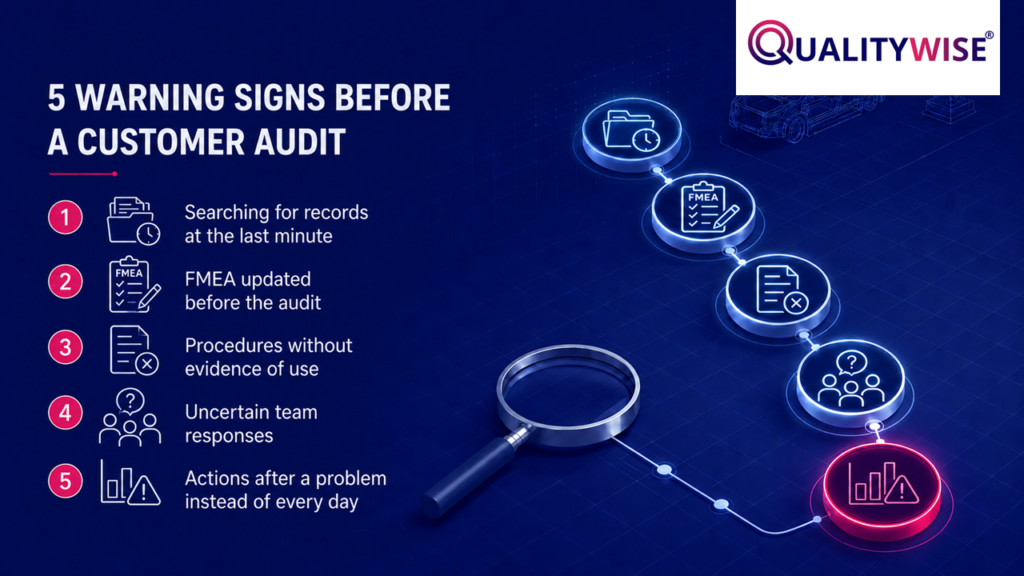
With this in mind, it is worth paying particular attention to five common warning signs.
1. Records are completed only after the audit date is announced
If the organization starts searching for missing records only after the audit date is known, it raises questions about whether the system is being applied consistently.
2. FMEA, the Control Plan, and work instructions are updated without a clear connection to a process change
A document may have a current revision date. However, that does not necessarily mean it reflects the current process risk.
3. Employees are given “ready-made answers” to auditor questions
An operator does not need to know the standard by heart. However, they should understand their work, acceptance criteria, relevant risks, and how to react when a problem occurs.
4. Actions following customer complaints are closed without confirming sustained effectiveness
Implementing an action does not automatically mean that the problem has been solved.
5. Internal audits focus on documents rather than the actual process
If an internal audit simply follows a document checklist, it may fail to identify what the customer will see directly on the shop floor.
Each warning sign on its own does not necessarily lead to a major nonconformity. However, several signs occurring together create a different picture. They may indicate that the organization cannot clearly demonstrate a consistent and effective management system.
How can you check audit readiness using just one process?
You do not need to begin by reviewing the entire management system.
A much more practical approach is to select one specific event.
For instance, select the most recent customer complaint, a significant internal nonconformity, or a recent process change. Then follow the entire chain.
Was the risk assessed? Next, check whether the FMEA was updated where necessary. Also verify that the change reached the Control Plan and work instructions. Then confirm that employees received the right information. Check whether the records show that the new method is actually being followed. Finally, verify its effectiveness.
Do not look for the perfect file.
Look for a logical chain of decisions and evidence.
This is one of the simplest ways to identify a gap before the customer auditor does.
Move beyond the documents and go to the workplace
The second step should be a conversation with the person actually performing the process.
You can ask:
- What is critical in this operation?
- How do you know when a result is unacceptable?
- What do you do when you detect a deviation?
- Where do you record the result?
- When do you escalate the problem, and to whom?
The purpose is not to check whether the employee has memorized the correct wording.
Instead, the purpose is to confirm that they understand their impact on quality. They should also be able to act in accordance with the established process.
If the answers are specific and consistent with the documentation, the organization is building credible customer audit readiness.
On the other hand, repeated answers such as “Quality knows that” should be treated as a warning sign. The same applies to “You need to ask the manager.” In both cases, the area deserves a closer review.
Select one high-risk process today and carry out this test. Then try to connect the FMEA, Control Plan, operator reaction, and records. If the connection is difficult to demonstrate, you have found a useful starting point for your gap analysis.
How can you build audit readiness without constantly “preparing for an audit”?
Ongoing readiness does not mean living permanently in audit mode. Nor does it mean creating more checklists, meetings, and reports. Instead, it means maintaining a simple and regular process management rhythm.
Process owners should know their current results, key risks, and open actions. The FMEA, Control Plan, and work instructions should reflect actual changes and quality events. Employees should also understand their control points and escalation rules. In addition, corrective actions should remain open until their effectiveness has been confirmed.
Internal audits also play an important role. A good audit should not only check whether a required document exists. Instead, it should observe actual work. It should also verify connections between system elements. Finally, it should test how the organization responds to real events.
As a result, a customer audit stops being an exceptional event.
It becomes another verification of a process that the organization already monitors on a regular basis.
What should you do if the audit is only a few days away and you find gaps?
This also happens in practice.
If your analysis reveals a problem shortly before the audit, the worst approach is to create the impression that the problem never existed.
First, assess the actual risk to the customer and the process. If immediate containment is required, implement it. Next, define clear responsibilities and actions.
Do not try to fix the entire system within a few days. Instead, focus on the highest-risk areas. Also prioritize places where documentation differs most from actual practice.
If you do not yet have complete evidence of effectiveness, do not manufacture it. Instead, show that the organization identified the problem and assessed the risk. Then demonstrate the containment that was implemented. Finally, show how the follow-up actions are being monitored. This is far more credible.
In fact, an organization’s ability to manage problems is one of the most important indicators of a mature quality management system.
True audit readiness does not mean perfection
An audit-ready organization is not an organization without nonconformities. Rather, it is an organization that can quickly answer several fundamental questions:
- What is currently the greatest risk in the process?
- How do we control it?
- What do we do when a result is outside the acceptance criteria?
- Were the most recent corrective actions actually effective?
- Has the knowledge gained from customer complaints and nonconformities been fed back into the FMEA, Control Plan, and the way the process is performed?
If the answers come from everyday management, the audit stops being a source of panic. It no longer depends on a presentation prepared for the customer visit. Instead, the audit becomes a verification of what the organization already knows about its process.
Ultimately, that is what sustainable customer audit readiness really means.
FAQ: audit readiness
How should a company prepare for a customer audit?
Start with the actual process rather than organizing folders. Check the connections between the FMEA, Control Plan, work instructions, and records. Then talk to employees about their daily work and how they respond to deviations.
Is up-to-date documentation enough to demonstrate customer audit readiness?
No. Current documentation is necessary, but it is not enough. The organization should also demonstrate that the defined rules are being applied. This includes competence, records, reactions to problems, and verified action effectiveness.
How often should audit readiness be checked?
Ideally, it should be checked as part of regular process management. This is particularly important after changes, customer complaints, and significant nonconformities. In addition, practical internal audits performed directly in the process are an effective tool.
What documents can a customer auditor review?
The scope depends on the customer and the level of process risk. In practice, it may include the FMEA and Control Plan. It may also include work instructions, inspection records, competence records, training records, audit results, customer complaints, and corrective actions.
What should you do if a gap analysis identifies problems before the audit?
First, prioritize the issues according to risk. Where necessary, protect the process or the customer. Next, assign clear responsibility for actions and define how progress will be monitored. Finally, verify that the implemented solution works in practice.
Check whether your organization is truly ready
If you want to assess the situation yourself, get access to our free Quality Management System Audit Readiness tool. Then use it to identify the greatest gap between declared and actual audit readiness.
If the result shows serious gaps, QualityWise can support you. This is particularly useful when the audit date is already approaching. Support may include an Audit Readiness Review, gap analysis, workshops for process owners, and practical IATF 16949 training. These activities can support quality, logistics, purchasing, HR, and laboratory teams.
The goal is not to prepare another presentation for the auditor. Instead, the goal is to build a system that can demonstrate its effectiveness through evidence generated by the everyday process.
All content on the qualitywise.pl website is a private interpretation of publicly available information. Any convergence of the described situations with people, organizations, companies is accidental. The content presented on the website qualitywise.pl does not represent the views of any companies or institutions.