In 2024, the automotive industry’s #1 nonconformity (due to its frequency) in third-party IATF 16949 audits was problem solving. It can therefore be said that organizations have a “problem” with consistently applying structured problem solving methods. In 2021, we wrote about the Top Ten Major NC’s . Almost 3 years later, problem solving is at the top of the list! In this article, we will look at the basic problem solving methods and how they stack up against each other.

Problem-Solving – what is it?
As a noun “the process of finding solutions to difficult or complex issues”
In Automotive Manufacturing, Problem-Solving is a series of steps and methods to understand a problem or issue. Moreover it is to find robust solutions to prevent recurrence.
How does this compare to previous NC’s?
| 2020 | 2021 | 2022 | 2023 | 2024 | |
| 10.2.3 Problem Solving | #2 | #1 | #1 | #1 | #1 |
| 10.2.1 Nonconformity & Corrective Action | #1 | #2 | #2 | #2 | #2 |
| 8.3.5.2 Manufacturing Process Design Output | #3 | #3 | #3 | #3 | #3 |
| 8.5.1.1 Control Plan | #4 | #4 | #6 | #6 | #4 |
| 8.5.1 Control of Production & Service Provision | #5 | #6 | #8 | #10 | #5 |
As we can see from the table, Problem-Solving is the top IATF 16949 Major Nonconformance in the last 4 years. Nonconformity & Corrective Action has dropped to second place.
What does this mean?
Our analysis finds that some organizations are unable to robustly solve problems and implement corrective actions.
This is not just audit findings during certification/recertification but real-world issues. Companies have ongoing problems which affect their manufacturing processes and customers.
Problem Solving Methods – Eight Disciplines Approach (8D)
By far the most common problem-solving method, 8D is used by Quality professionals, Suppliers and OEM’s to solve problems in eight steps.

This method typically takes around 30 days to go from D0 to D5. Some OEM’s require the 8D Summary Report to be submitted in full by day 30. And the adoption of Permanent Countermeasures (D6) within 90 days from concern notification.
Note: different OEMs may have their specific requirements regarding timing of 8D!
Problem Solving Methods – A3 Report
This type of problem-solving method was developed by Toyota and follows a similar approach to 8D. The idea is that the problem-solving investigation and findings are illustrated on an A3 single sheet of paper (297 x 420 mm). The A3 approach can be easily understood by top management and working-level teams.

Problem Solving Methods – QRQC
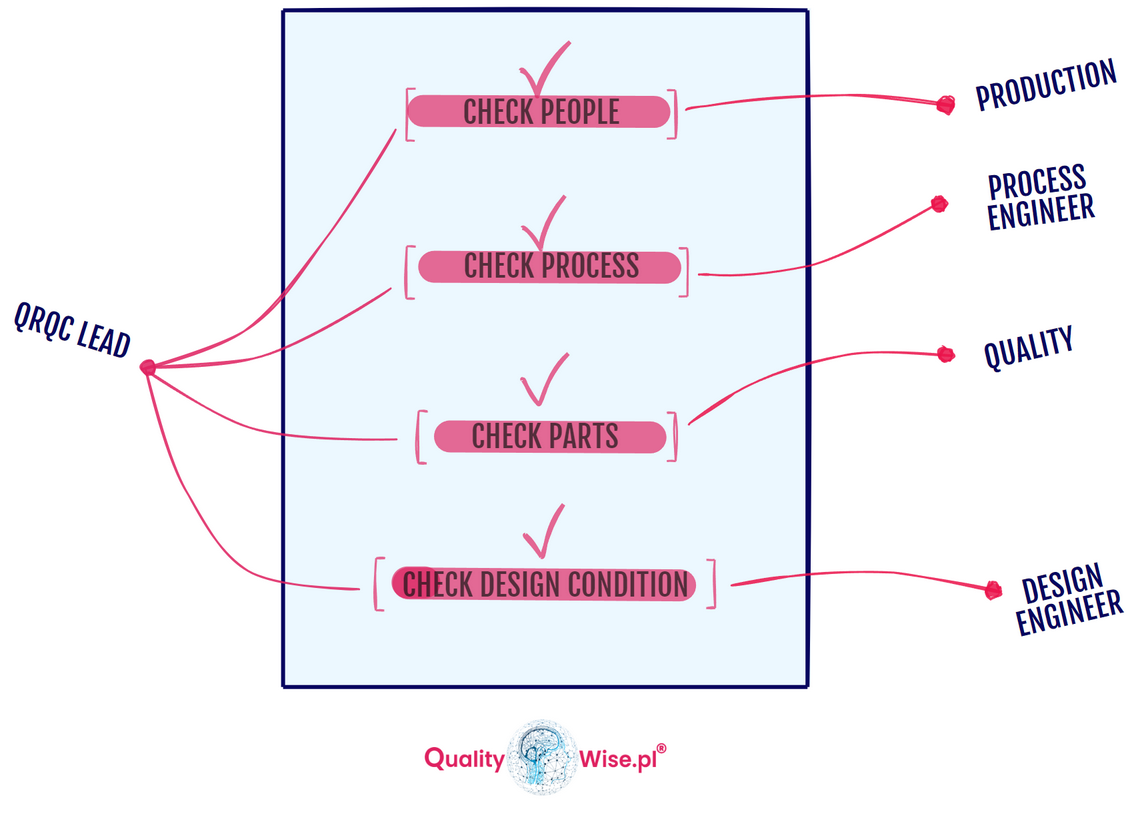
Quick Response Quality Control (QRQC) focuses on rapid resolution to problems and assigns ownership of actions within the QRQC meeting. This is a culture-driven problem-solving method and is clear in the 4 steps: Detection, Communication, Analysis and Verification.
QRQC supports escalation to next-level management when actions are not completed on time during the problem-solving process.
Which Problem Solving Method is best?
The short answer is all! Each has its pros and cons. Fundamentally being able to describe the problem with facts and data, implementing initial containment, finding the true root cause and verifying robust permanent countermeasures is key to any problem-solving method.
Tips for Problem-Solving
1. Clearly describe the problem. We recommend using 5W2H. Example:
A concern was highlighted by Customer X regarding a Wheel Bearing with a stiff operation.
Investigation into the concern found that the part was incorrect to the specification. The product specification states that the part must rotate freely at a maximum effort of 2N. The NG part was found to generate 10N of force.
All stock was checked with no further issues found. 89 OK, 1 NG.
2. Communicate the problem and countermeasures to key stakeholders.
3. Define and verify permanent corrective actions to prevent the problem from being repeated.
4. Review and update supporting documentation. Example: SOP’s, FMEA’s, Engineering Drawings, Control Plans and Design Guides as part of continuous improvement.
Problem Solving in IATF 16949:2016
It’s important to understand the link between Problem-Solving and IATF 16949.
Section 10.2.3 states that there shall be a structured approach to identifying, analysing and the resolution of problems within a company’s processes, services or products.
There must be a documented process for problem solving which covers:
- Ongoing manufacturing issues.
- New Product Development.
- Audit Results.
- In Service Field Failures.
IATF 16949 does not mandate a particular problem-solving method, the supplier shall follow either the customer-prescribed method or may use a method which covers key activities as highlighted in this article.
Listen to the podcast
Let’s sum up!
By adopting problem-solving methods which can support different types of issues and scenarios, your organization will be able to continuously improve and prevent significant disruption to your processes.
Quality professionals and general team members need to be trained effectively to be able to support concern investigations. We invite you to “The Effective Problem Solving” training organized by Qualitywise, where you will learn in detail about different methods in problem solving. Ask about the date.
We hope that with this article you will be able to understand the different types of problem-solving methods and how to work through each step!
For people who want to know more:
IATF 16949: 2016 Requirements for quality management systems in serial production and the production of spare parts in the automotive industry, 1st edition, 2016
All content on the qualitywise.pl website is a private interpretation of publicly available information. Any convergence of the described situations with people, organizations, companies is accidental. The content presented on the website qualitywise.pl does not represent the views of any companies or institutions.