
Management review is – we dare to call it – the most important activity in quality management system (QMS). It is essential because it offers a structured way to evaluate the system’s performance, ensure alignment with strategic objectives, and uncover opportunities for improvement. By assessing key data points and making informed decisions, management reviews help organizations uphold high standards and adapt effectively to changes in both internal operations and external context. Both ISO 9001 and IATF 16949 emphasize the importance of these reviews in achieving compliance, maintaining efficiency, and ensuring customer satisfaction. However, common mistakes during these reviews can undermine their purpose. This article highlights frequent mistakes to improve review effectiveness.
What is a Management Review?
Management reviews are formal evaluations conducted by an organization’s leadership to assess the performance of their QMS. These reviews focus on critical factors such as customer satisfaction, process efficiency, and compliance with ISO 9001 and IATF 16949 standards. By understanding the significance of management reviews, organizations can enhance operational efficiency and maintain meeting quality standards’ requirements.
Management Review requirements in ISO 9001 and IATF 16949
General Requirements in ISO 9001:2015 point 9.3.1 are saying that management reviews must evaluate the organization’s QMS for its suitability, adequacy, effectiveness, and alignment with strategic objectives.
Reviews should be conducted at planned intervals. However in point 9.3.1.1 IATF is saying „Management review shall be conducted at least annually. The frequency of management reviews shall be increased based on risk to compliance with customer requirements resulting from internal or external changes impacting the quality management system and performance-related issues.”
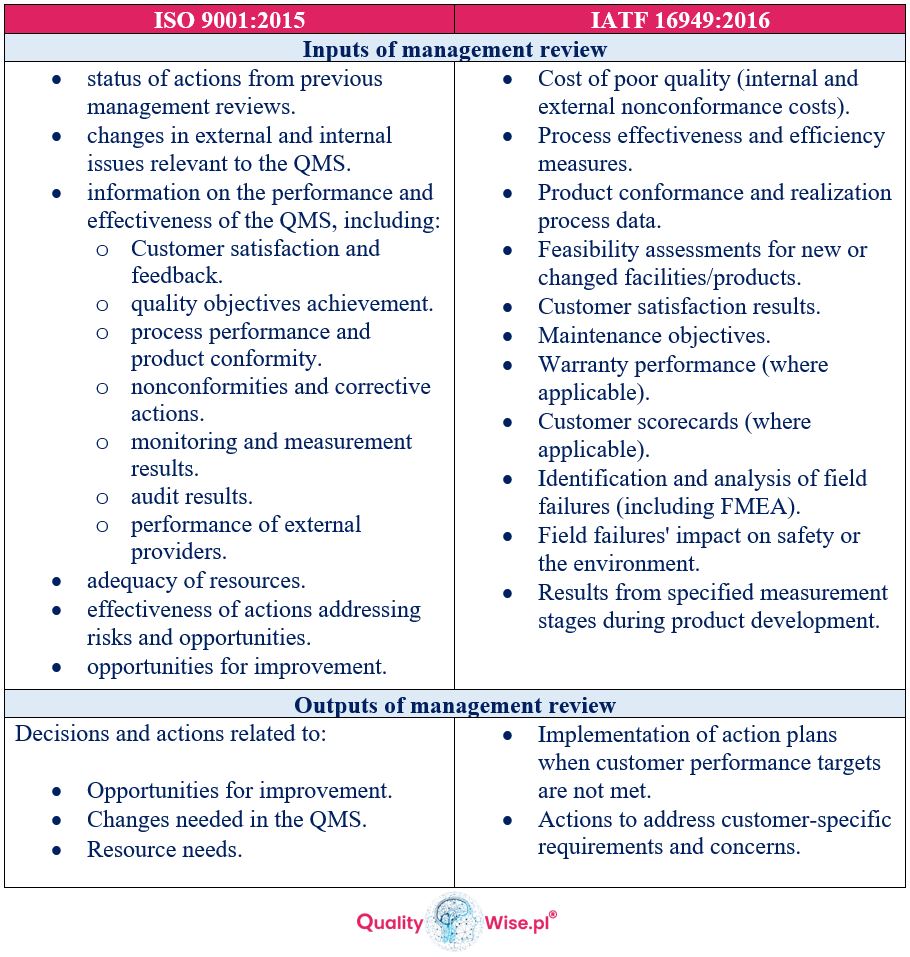
ISO 9001:2015 and IATF 16949:2016 are giving also a certain list of inputs and outputs from management review.
Management Review Mistakes
1. Neglecting defined input criteria
ISO 9001:2015, clause 9.3.2 and IATF 16949:2016, clause 9.3.2.1 clearly define the inputs necessary for effective management reviews. We collected them in the table above. Organizations often fail to comprehensively gather and present this data, relying on outdated or incomplete information. For example, they might use customer feedback from years ago or overlook audit findings from recent months.
2. Overlooking the importance of customer feedback
Customer satisfaction is a cornerstone of both ISO 9001 and IATF 16949. These standards emphasize that organizations must not only meet but exceed customer expectations. ISO 9001:2015, clause 9.1.2, and IATF 16949:2016, clause 9.1.2.1 specifically require the analysis of customer feedback received from different sources i.e. customer scorecards, complaints, and satisfaction trends based on internal monitoring. Some organizations treat customer feedback as secondary or fail to trace recurring issues to their root causes, which can lead to ongoing dissatisfaction.
Remember, allocate time during management reviews to thoroughly assess customer satisfaction data.
3. Failing to address risks and opportunities
The ability to identify and address risks and opportunities is a critical requirement of ISO 9001:2015 and IATF 16949:2016. These provisions ensure the QMS remains resilient and aligned with organizational goals. Many organizations focus on immediate problems without considering long-term risks or potential growth opportunities. This reactive approach limits the strategic value of management reviews. Risks and opportunities management shall be proactive.
4. Insufficient evaluation of QMS effectiveness
Management reviews are a key opportunity to assess whether the QMS is achieving its intended outcomes. ISO 9001:2015,clause 9.3.2 and IATF 16949:2016, clause 9.3.2.1 mandate that organizations evaluate QMS effectiveness during these reviews.
Organization must avoid this mistake: Assuming that processes are effective without analyzing measurable outcomes! Don’t forget to track whether past corrective actions have resolved identified issues.
5. Neglecting resource assessment
Effective resource management, as outlined in ISO 9001:2015, clause 7.1, is fundamental to achieving quality objectives. This includes ensuring adequate personnel, infrastructure, and technological resources.
Organizations often overlook whether their current resources are sufficient, leading to employee burnout, outdated equipment, or a lack of training. Many times while auditing organization it was seen that each single process struggle with lack of resources but in management review report there was nothing mentioned about it!
During management review, assess resource adequacy comprehensively. Identify areas where investments in technology or infrastructure are needed to support operational goals…The same with headcount…
6. Conducting reviews too infrequently
ISO 9001:2015, clause 9.3.1, require that management reviews be conducted at planned intervals. The frequency should reflect the complexity of the organization and the dynamics of its operating environment. And remember what IATF 16949 is saying about time intervals. As already written above in this article „Management review shall be conducted at least annually.” And do you remember what was stated about frequency? Reviews are either scheduled too infrequently or conducted as a formality. Thus they result in superficial evaluations and delayed responses to critical issues.
Align review frequency with business cycles and strategic priorities. For example, high-change industries may benefit from quarterly reviews, while annual reviews may suffice for stable operations. Ensure reviews are structured, with prepared agendas and actionable follow-ups to maintain focus and drive meaningful improvements.
Listen to our podcast
Conclusion: why effective management review matter
Management reviews are a system mechanism for ensuring the effectiveness and continuous improvement of a QMS. Avoiding common mistakes can transform reviews from routine meetings into strategic opportunities for growth. By adhering to the requirements of ISO 9001 and IATF 16949 and adopting a proactive, data-driven approach, organizations can optimize their management review. Thus it will enhance efficiency, meet customer expectations, and achieve strategic direction to meet business goals.
Do you want to know more?
We invite you to the ISO 9001 and IATF 16949 organized by Qualitywise, where you will learn in detail all the requirements for the quality management system. Ask about the date.

Hope you found this article interesting. If you wish to receive our articles directly to your mailbox sign up to the newsletter!
Thank you for your presence.
For people who want to know more:
Knowledge must have a solid foundation in order to avoid information noise. Therefore, the article was based on the following literature:
IATF 16949: 2016 Requirements for quality management systems in serial production and the production of spare parts in the automotive industry, 1st edition, 2016
All content on the qualitywise.pl website is a private interpretation of publicly available information. Any convergence of the described situations with people, organizations, companies is accidental. The content presented on the website qualitywise.pl does not represent the views of any companies or institutions.