In many automotive organizations, IATF requirements related to manufacturing process audits and CSR expectations, as well as AIAG CQI special processes guidelines, exist only on paper. On one hand, checklists are completed. However, on the other hand, the process still generates complaints, and customer audits often end in a tense atmosphere.
So why does this happen? In practice, CQI is very often treated as a formal obligation rather than a process risk management tool. However, this is exactly where its greatest value lies. Therefore, in this article, we will show you how to approach CQI so that it truly stabilizes the process instead of just looking good during an audit.
What are CQI special processes and why do they cause so much confusion?
In automotive, CQI means two things at the same time. First, Continuous Quality Improvement, which refers to a mindset of ongoing improvement. Second, and more importantly in practice, it refers to the family of AIAG CQI Special Process Assessments, which are standardized self-assessments for special processes.
However, the problem is that many organizations focus only on completing the forms. As a result, CQI special processes become a document rather than a practical tool. In fact, “YES” answers are often not supported by real evidence, and customer audits quickly expose this gap.
In other words, CQI stops managing the process.
Why do CQI special processes require a different approach in automotive?
Special processes share one key characteristic. You cannot fully verify product quality through standard inspection.
Special processes follow their own rules. A special process is one where results cannot be fully verified immediately after the process or during subsequent operations.
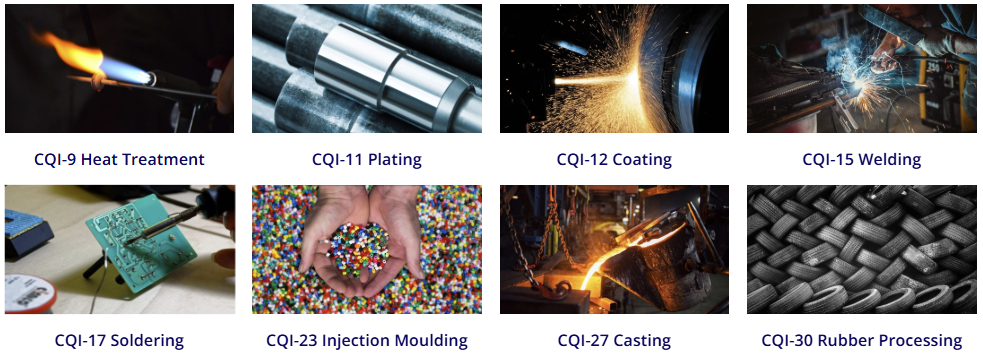
For example, this applies to heat treatment, welding, coating, soldering, or plastic molding. As a result, a process error may remain invisible, may only appear at the customer, and its detection often requires destructive testing.
For this reason, CQI special processes require a shift in thinking. You do not control the product. Instead, you control the process. More precisely, you control parameters, competencies, equipment, and reaction plans.
Overview of CQI special processes – which assessments apply to your organization?
In practice, there are several key CQI assessments for special processes:
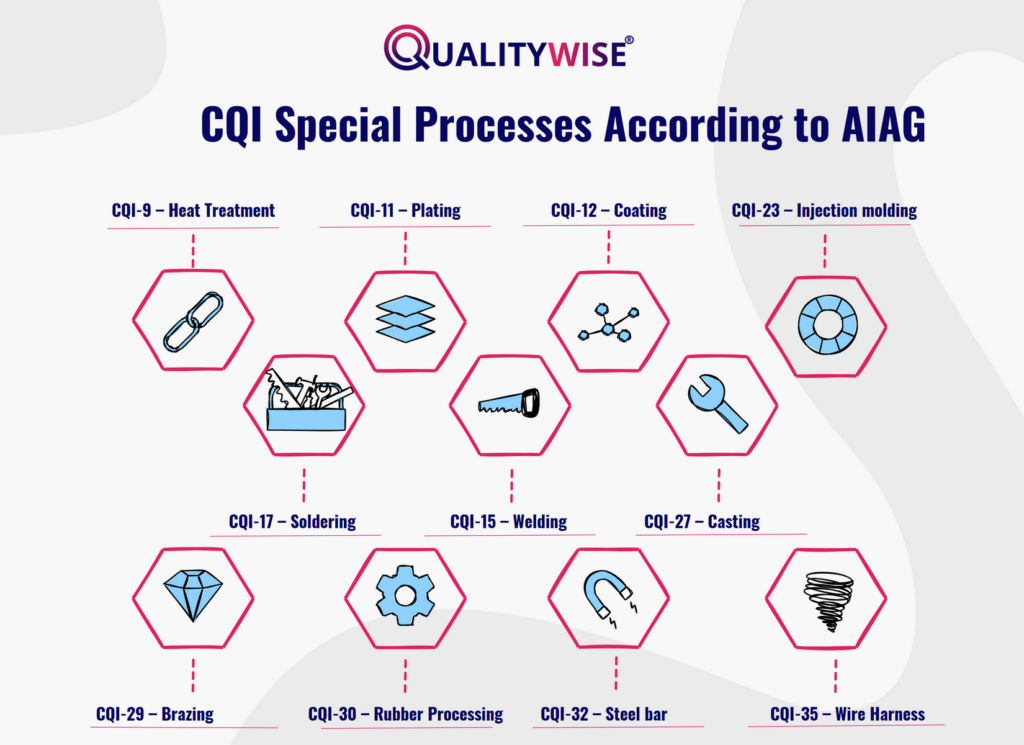
Each of these assessments includes two key elements. First, the system assessment, which evaluates management, training, maintenance, and methods. Next, the job audit, which verifies real production jobs. This is where the gap between theory and practice becomes most visible.
In addition, it is worth remembering that beyond special process assessments, there are other CQI guidelines and manuals. These support the organization at a system level; however, they are not special process assessments.
How do CQI special processes support IATF 16949 and Core Tools in practice?
CQI does not operate separately from the quality management system. On the contrary, it is its operational layer.
Connection with APQP and PPAP
First, CQI job audits show whether the Control Plan actually works in practice. They also confirm whether parameters are maintained and whether reaction plans are applied on the shop floor.
Connection with PFMEA
Moreover, every special process risk should be reflected in CQI special processes. It should also be controlled through defined parameters and reactions. Otherwise, PFMEA becomes disconnected from reality.
Connection with SPC and MSA
Finally, CQI special processes clearly define which parameters are critical and which measurement systems must be stable. As a result, it becomes easier to align customer requirements with daily process control.
If you are not sure whether your CQI supports PFMEA and the Control Plan, this is the first signal that your system lacks consistency.
How to implement CQI special processes step by step – a practical approach
Based on audit experience, one thing is clear. The biggest mistake is treating CQI as a “once-a-year” activity. Therefore, it should be approached as a continuous process.
1. Map applicability
First, identify which processes require CQI, where they occur, and which products they apply to. Customer-specific requirements can support this step.
2. Assign ownership
Next, ensure that each process has a system owner as well as job audit leaders, including at shift level.
3. Perform an honest self-assessment
Importantly, do not beautify the results. It is better to have red points than a green report followed by customer complaints.
4. Run job audits on real production
Then, avoid selecting the best shift or the ideal job. The customer will not do that. Instead, audit the real process, not its best-case version.
5. Close gaps systemically
After that, ensure that each deviation is reflected in PFMEA, updates the Control Plan, and has an assigned owner and deadline.
6. Sustain the system
Finally, remember that CQI special processes are not a one-time event. They require routine, monitoring, and continuous improvement.
CQI special processes – most common implementation mistakes and how to avoid them
- CQI as paperwork – require real process evidence, not declarations.
- No job audits – treat them as a key element, not an addition.
- Parameter drift – set alarms and reactions directly at the process level.
- Disconnected PFMEA – update risk analysis based on CQI results.
- Annual CQI project – integrate CQI into daily process management.
FAQ – frequently asked questions
Is CQI a certification?
No. CQI is a self-assessment based on AIAG guidelines, often reviewed by customers or during second-party audits.
How often should CQI special processes be performed?
Typically at least once per year and after significant process changes. However, you should always verify customer-specific requirements and consider process risk and performance.
Does every plant need to implement all CQI special processes?
No. CQI applies only where a given special process exists. For example, a molding plant will use CQI-23, while a heat treatment supplier will use CQI-9.
Do you need support with CQI?
Do you want to implement or improve CQI special processes so that they truly stabilize your process, not just pass an audit? Check out QualityWise® trainings. We will show you how to translate CQI into real business results. Alternatively, book a free consultation if you need support with CQI audits.
Summary
CQI for special processes is not just “another AIAG requirement to check off.” It is a very practical tool that—when implemented properly—helps you:
- detect risks before your customer does,
- stabilize processes where traditional quality approaches start to fail,
- and significantly reduce the cost of defects, complaints, and nonconformities.
The problem? In many organizations, CQI exists only as a periodic audit—completely disconnected from daily process management. And when that happens it doesn’t prevent problems, it doesn’t support operational decisions, and it doesn’t build any real quality advantage.
So the real question is not: “Do you have CQI implemented?” But:
“Is your CQI actually protecting your process?”
All content on the qualitywise.pl website is a private interpretation of publicly available information. Any convergence of the described situations with people, organizations, companies is accidental. The content presented on the website qualitywise.pl does not represent the views of any companies or institutions.