Recruitment for the quality department has always required precision. Yet today, in an era shaped by artificial intelligence, data-driven decision-making and automation, it has become one of the most strategically complex HR tasks. According to the World Economic Forum’s Future of Jobs Report 2025, almost 44% of core skills will change by 2027, particularly in manufacturing, automotive and industrial sectors. Quality departments sit at the centre of this transformation — bridging operations, compliance, and customer satisfaction.
A decade ago, a “quality professional” was mainly responsible for ensuring process compliance, performing inspections, and managing audits. Now, the same role demands analytical thinking, systems understanding, collaboration with digital teams, and the ability to make data-led decisions in uncertain environments. In short, we are no longer recruiting controllers of defects, but rather architects of quality culture — professionals capable of preventing issues, interpreting trends, and driving continuous improvement across the organisation.
From compliance to competence: the new DNA of quality professionals
The OECD’s Employment Outlook 2025 and The LinkedIn Learning Workplace Learning Report 2025 highlights that future employability depends on combining technical and socio-emotional competences. The best-performing organisations already design recruitment profiles around this integration.
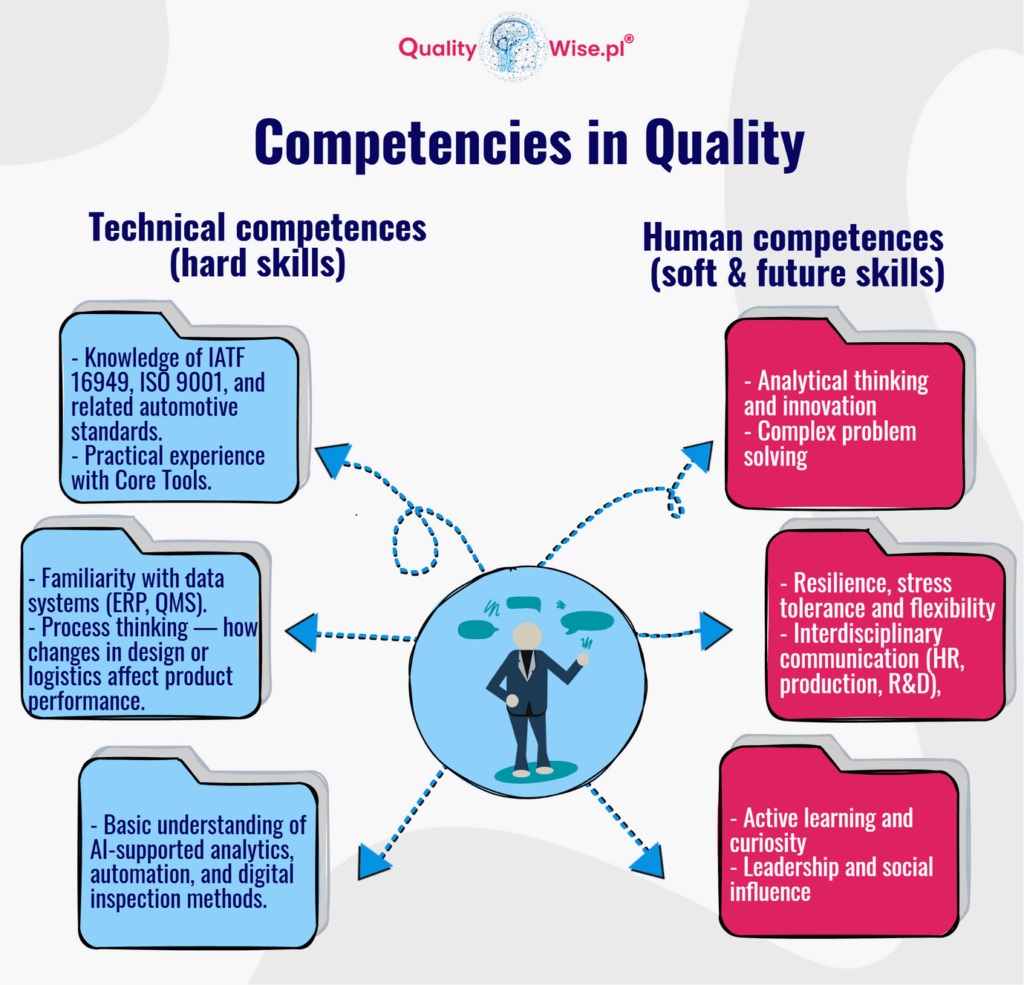
1. Technical competences (hard skills)
A solid candidate for a modern quality role should master:
- Knowledge of IATF 16949, ISO 9001, and related automotive standards.
- Practical experience with Core Tools: APQP, FMEA, MSA, SPC, PPAP, Control Plan.
- Familiarity with data systems (ERP, QMS, or statistical tools such as Minitab).
- Basic understanding of AI-supported analytics, automation, and digital inspection methods.
- Process thinking — how changes in design or logistics affect product performance.
2. Human and meta competences (soft & future skills)
Technical skills alone are no longer enough. The LinkedIn Learning Workplace Learning Report 2025 identifies the following as the fastest-growing professional skills across industries:
- Analytical thinking and innovation
- Complex problem solving
- Resilience, stress tolerance and flexibility
- Active learning and curiosity
- Leadership and social influence
These findings mirror those of the WEF 2025 report, where analytical thinking, creativity and empathy top the list of “skills in demand”. In the quality context, these competences translate into the ability to challenge assumptions, read between the data, communicate with diverse teams, and balance compliance with improvement.
Why HR and Quality must recruit together
One of the recurring challenges in recruitment for the quality department is the disconnect between HR and technical managers. HR understands behavioural assessment, but may not recognise whether a candidate’s knowledge of FMEA or SPC is truly advanced. Meanwhile, quality managers can assess technical accuracy but not necessarily cultural fit or learning agility.
The most forward-thinking organisations address this by building joint recruitment models.
As McKinsey’s A New Future of Work (2024) report emphasises, cross-functional hiring teams achieve up to 40% higher success in identifying high-performing talent.
Practical example
During recruitment for a supplier quality engineer, HR might focus on adaptability, values alignment, and motivation, while the quality manager evaluates the candidate’s analytical method and decision-making approach using a short data case.
This dual assessment ensures that both the “skills fit” and the “mindset fit” are validated before an offer is made.
Redefining the recruitment process for quality roles
Recruitment for the quality department should evolve from checklist-based evaluation to competence-based assessment. Let’s explore how.
1. Define future-proof competence profiles
Start by identifying the competences that will be critical for your organisation in the next three to five years.
The WEF Future Skills Framework defines four pillars that every recruiter in quality should use as a reference:
- Analytical thinking and innovation
- Complex problem solving
- Technology literacy
- Collaboration and resilience
These four pillars form a foundation for what we call Quality 4.0 talent — a person able to integrate technology, people and processes.
2. Use data-driven selection methods
Relying solely on CVs is no longer sufficient.
The LinkedIn Workplace Learning Report 2025 shows that organisations focusing on competences rather than experience reduce time-to-hire by 25% and turnover by 30%.
In practice, this means designing structured interviews and tasks that measure thinking patterns — for example, a simulation where the candidate analyses a set of process deviation data and proposes an improvement plan.
3. Include practical assessment scenarios
Many organisations now use mini-assessments as part of the recruitment process. Examples include:
- Analysing a case study from a real customer complaint.
- Interpreting an SPC chart and identifying probable causes.
- Explaining a risk mitigation plan based on FMEA results.
Such exercises allow HR and hiring managers to see how a candidate reasons, prioritises and communicates under pressure — competencies that traditional interviews rarely reveal.
4. Measure learning agility
According to the OECD’s Skills That Matter for Success and Well-being in Adulthood (2025), the most successful professionals are those who continuously learn and unlearn.
Therefore, one of the best interview questions HR can ask is:
“What is the most recent skill you have learned related to quality — and how did it impact your work?”
A candidate who can answer this concretely demonstrates curiosity and self-development, both essential for future quality roles.
Ten interview questions to identify true quality potential
Recruitment for the quality department benefits greatly from structured behavioural questions. Here are ten practical questions you can integrate into your process:
- How do you define “quality” from the customer’s perspective?
- What steps would you take if a process capability index suddenly dropped below target?
- Tell me about a time when you persuaded others to change a process or mindset.
- Which is more important to you — compliance or problem prevention? Why?
- What quality tool do you find most underestimated, and why?
- How do you handle conflicting priorities between production and quality?
- Describe how you use data to make daily decisions.
- What do you do when your analysis contradicts your manager’s expectations?
- What new skill or tool are you planning to learn this year?
- What is the difference between quality control and quality management in your view?
These questions reveal analytical reasoning, ethical integrity, communication style, and readiness for continuous improvement — precisely the attributes outlined in the McKinsey “Superagency in the Workplace” (2025) report, which advocates for empowering employees to use AI and data insightfully.
Beyond recruitment: retaining and developing quality talent
Hiring the right candidate is only half the equation. The OECD 2025 Employment Outlook shows that 70% of talent loss in industrial sectors occurs not due to pay but due to a lack of learning opportunities and impact recognition.
To retain top quality professionals:
- Invest in Core Tools and other quality basic training.
- Build cross-functional development paths (Quality–Production–Engineering).
- Encourage mentorship and knowledge sharing between senior experts and younger engineers.
- Recognise contribution to prevention, not only firefighting.
As McKinsey notes, organisations that create a learning ecosystem around quality see up to 30% improvement in problem-solving efficiency and 20% faster implementation of corrective actions.
How technology changes the competences required in quality
Artificial intelligence is not replacing quality roles — it is reshaping them. The WEF 2025 report highlights AI and big data specialists among the fastest-growing roles globally. For quality professionals, this means a shift towards interpreting insights rather than collecting data.
Modern quality departments are evolving into data intelligence hubs, combining human judgement with algorithmic support. To recruit effectively, HR and hiring managers should therefore prioritise competences such as:
- Understanding AI limitations and data bias.
- Ability to validate algorithmic decisions.
- Collaboration between engineers, IT, and quality analysts.
In practice, this creates a new hybrid role — Quality Data Analyst — merging traditional problem-solving with advanced analytics.
The future of recruitment for the quality department
The global data paints a clear picture. According to WEF, McKinsey, OECD and LinkedIn, the future of quality depends on integrating:
- Data literacy and AI awareness,
- Systems thinking and collaboration,
- Continuous learning and emotional intelligence.
In the coming years, quality departments will no longer be reactive units. They will become strategic centres of organisational intelligence — predicting, preventing, and designing resilience into processes.
For HR, this means moving from competence matching to competence shaping. For Quality leaders, it means becoming mentors who attract and grow talent, not just auditors who enforce standards. Ultimately, the quality of recruitment defines the quality of the organisation itself.
Looking for practical tools to strengthen your quality team?
Download our free QualityWise e-books packed with real examples, competency frameworks, and recruitment tips you can apply immediately.
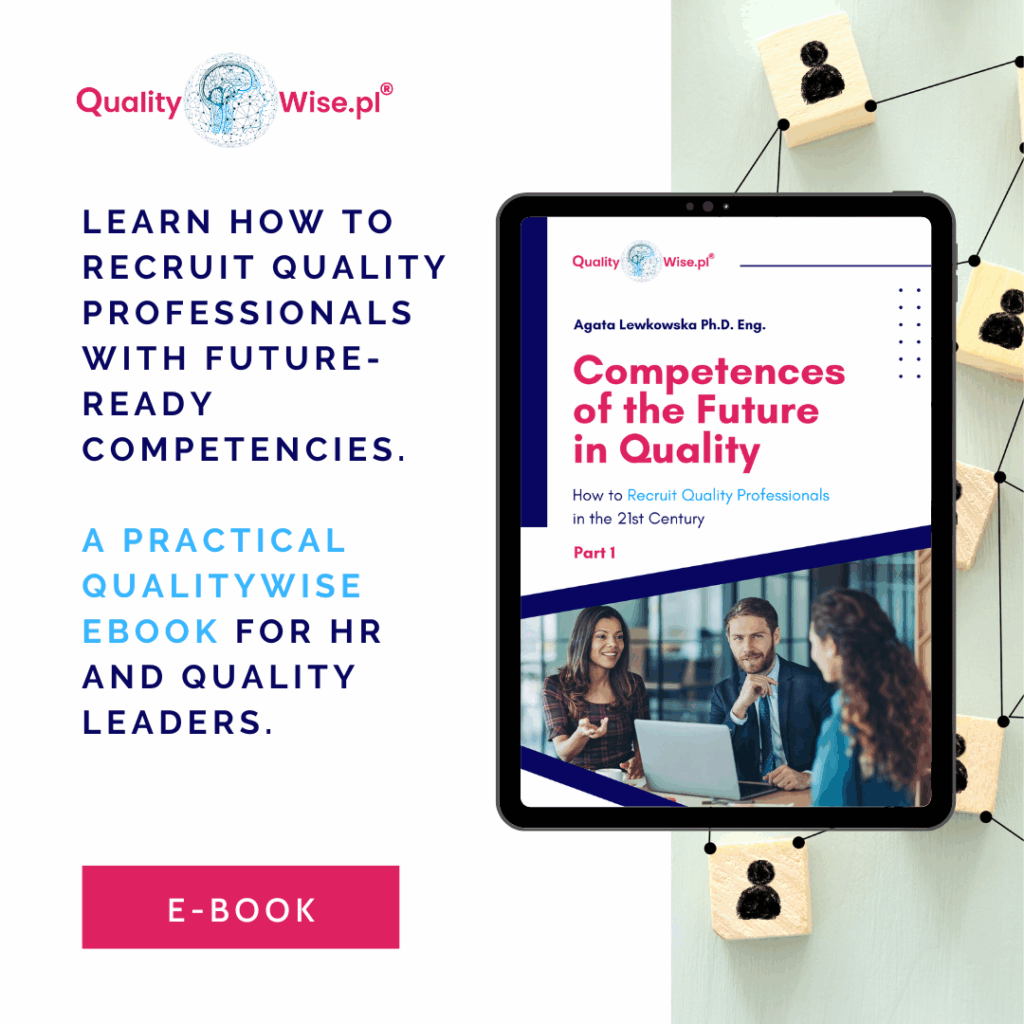
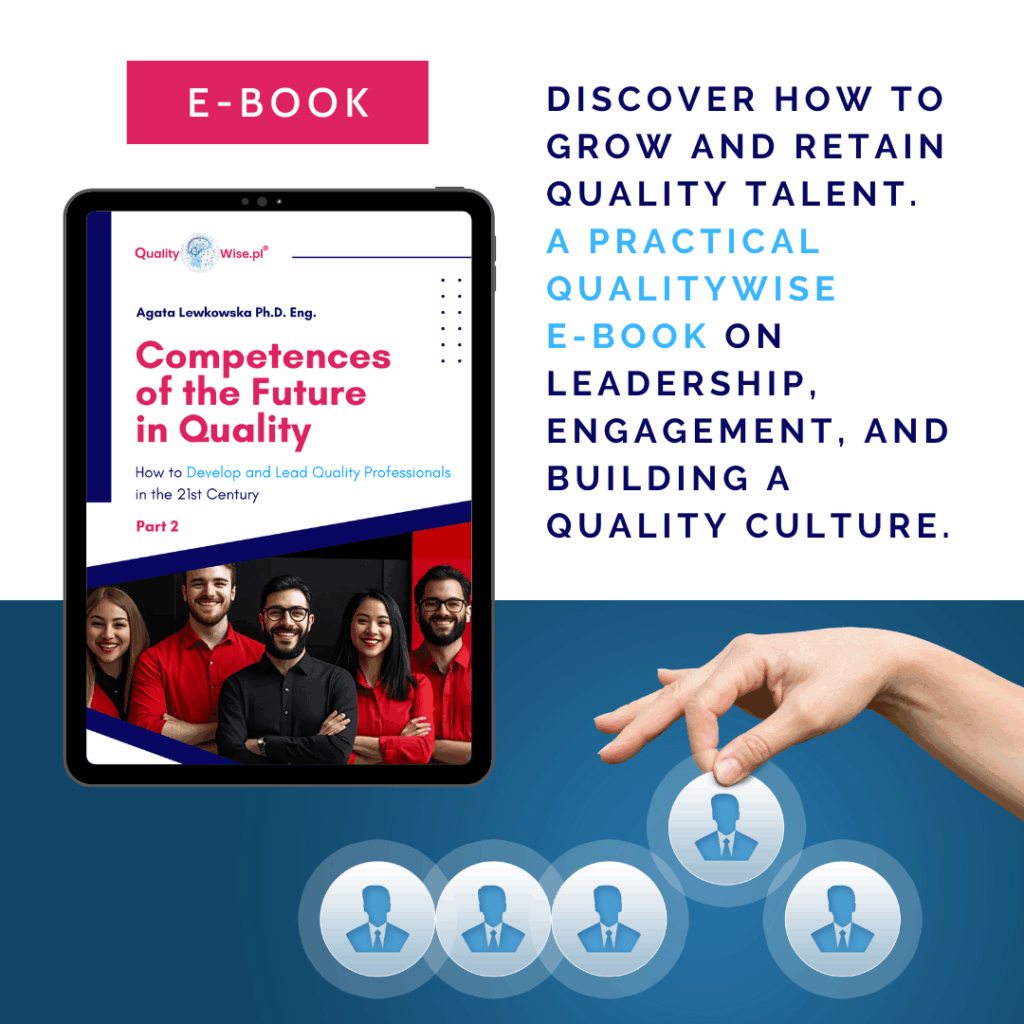
Get the e-books here and start building a stronger quality department today.
Recruitment for the quality department – Conclusion
Recruitment for the quality department is undergoing a paradigm shift.
The most successful organisations are those that:
- Recruit for mindset, not only for skills.
- Build bridges between HR and Quality.
- Use assessment to reveal thinking patterns, not just knowledge.
- Invest continuously in competence development.
The future belongs to companies that treat quality as a human and cultural competence — not just a compliance function.
Build the competencies your Quality team needs
Would you like to strengthen your organisation’s ability to recruit, develop and retain high-quality talent? Explore Qualitywise® trainings’ portfolio …and get familiarized with Qualitywise® FLEX PLAN

Hope you found the article interesting.
Thank you for your presence.
All content on the qualitywise.pl website is a private interpretation of publicly available information. Any convergence of the described situations with people, organizations, companies is accidental. The content presented on the website qualitywise.pl does not represent the views of any companies or institutions.